

Looking Back: A Year of Growth & Connection for the Universal Care Plan
As 2025 comes to an end, it’s a good moment to reflect on how far the UCP has come and how much closer we are to delivering truly joined-up, personalised care across London.
This year began with a major milestone: the expansion of UCP use cases to include dementia, frailty, carer contingency planning and learning disabilities. These additions have broadened the purpose of UCP, helping teams capture what matters to people earlier, more consistently and in a way that supports better day-to-day care as well as urgent and crisis management.
We also delivered our GP Connect integration functionality, giving professionals instant access to the latest medications and allergy information from the GP record. This has been one of the clearest examples of how digital connection can improve safety and reduce duplication across urgent, community and social care settings.
Our work with local adoption groups has continued to strengthen awareness and uptake. UCPs for people with frailty have increased by 49%, and for those with dementia by 19% with over 11,000 UCPs having dementia and/or frailty recorded. UCPs for those with learning disabilities and/or autistic people have increased by 42%, reaching over 1000 people. More organisations, clinical teams and local authorities are now embedding UCP as part of routine practice, helping us move steadily towards consistent, London-wide use.
A significant focus this year has also been aligning UCP with the ambitions of the new NHS 10-Year Plan. The plan’s emphasis on prevention, community-based care and digital interoperability aligns strongly with the role UCP plays in supporting Integrated Neighbourhood Teams.
We’ve seen particularly strong progress in Bexley and across North East London, where neighbourhood teams are using the UCP to bring professionals together around the needs of individuals with complex conditions.
As we look ahead to 2026, the foundations we have built this year put us in a strong position to continue supporting systems to deliver more coordinated, compassionate care. We will continue to develop our NHS login and NHS app integrations to enable create and edit access for patients. Despite some unexpected delays, we are determined to deliver this functionality for patients, truly giving them ownership of their plans. We will also continue to expand our care planning solution to meet the needs of those with Mental Health conditions and catheters.
Thank you to everyone across health, social care and the voluntary sector who has contributed to this progress. Your commitment is what makes the UCP meaningful for the people it serves.
We wish you a relaxed festive season. Bring on 2026!
UCP Team
Havering Liberty PCN Aligned Community Team (PACT) Use of UCP in Proactive Care for Frail Patients
This month, we’re highlighting how the Havering Liberty PCN Aligned Community Team (PACT) has been using the UCP. Dr Mary Burtenshaw, GP Partner (Hornchurch Health Care) shared more about the team and their work:

“PACT started in July 2024 to deliver proactive, person-centred care for housebound and frail patients, addressing gaps in traditional reactive models. It operates within a multidisciplinary framework, linking primary care, community teams, social prescribers, and secondary care frailty services and has been highly commended for its collaborative approach to care. Central to this approach is the integration of UCPs, which ensure that patients’ preferences, clinical needs, and anticipatory strategies are documented and accessible across the system.
UCPs are developed during home visits by Advanced Clinical Practitioners (ACPs) as part of a comprehensive geriatric assessment, alongside structured medication reviews and advance care planning. This enables timely interventions and reduces avoidable hospital admissions by providing clear guidance for urgent situations. Since PACT began, it has provided over 650 unique patients with a UCP and the content is reviewed at each follow up appointment.
The PACT team also participates in a monthly MDT meeting which is beneficial to review cases and peer-review of UCPs, ensuring consistency and quality. By embedding UCPs into proactive care pathways, PACT empowers patients and carers, supports continuity, and promotes ageing well at home. This integrated model not only addresses medical needs but also considers social and environmental factors, creating a holistic approach to frailty management. PACT was highly commended by NEL faculty of RCGP in the category of collaborative working and were shortlisted in the collaborative care category for the 2025 London Personalised Care Awards“
London Personalised Care Awards
We’re thrilled to announce that we won the Living in a Digital Age category at the 2025 London Personalised Care Awards. This achievement highlights the growing impact of the UCP in supporting more personalised, joined-up care and reflects the collective work of teams across London who contribute to its development and use.
Thank you to everyone who has contributed to this work!

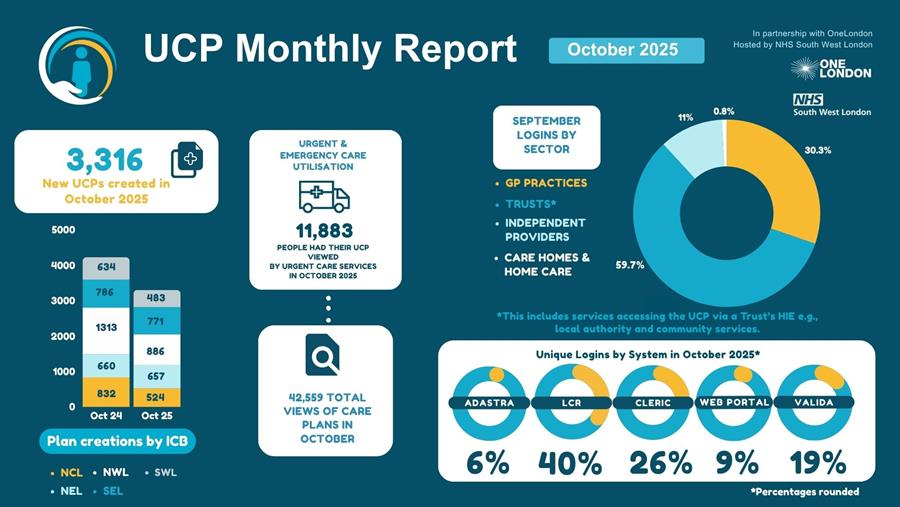
UCP Monthly Report
Care plan accesses and log-ins reached a new all-time high in October – thank you to everyone who’s contributed towards this!
New Cleric CAD integration for London Ambulance Service
In November, the UCP went live with an integration with London Ambulance Service’s Cleric CAD system that makes access quicker and more streamlined for crews. This integration flags patients with a UCP when the patient can be verified via a PDS search, and allows a real time lookup of possible matches based on location if patient details cannot be verified. The integration also allows Cleric CAD users to launch and view the care plan in-context.
Consultation on New Regional CPR Guidance for Adults
The London Palliative and End of Life Care Clinical Network has developed draft regional guidance on Cardiopulmonary Resuscitation (CPR) recommendations in adults. The aim is to support the use, best practice and transferability of CPR recommendations across organisational boundaries, so they accompany a person and apply in all settings. The guidance is intended to complement, rather than replace or duplicate, existing relevant local healthcare policies and procedures.
The consultation of the draft guidance will launch on Friday (4th December) and will run until January 2026. Once this guidance is finalised, the UCP CPR form will be reviewed to ensure it supports the new guidance. If you would like to share your feedback on the draft guidance, please complete the Microsoft form. More information can be found here.
Dates for the Diary
16th December – UCP People with Lived Experience group meeting.
17th December 10-11am – Learning Disability UCP Champions meeting. Following on from a series of webinars focused on how the UCP can support people with a learning disability, NHSE’s Learning Disability, Autism & SEND team have introduced a champions group to bring people working in LD services together to discuss the UCP. If you would like to be involved, get in touch here.